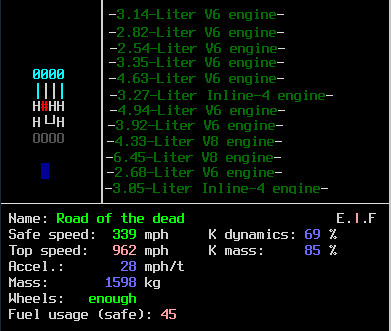
[quote=“ballfairy, post:40, topic:248”]this is officially the most chucking futs’ thing ive ever built, found 2 more enjhuns need more V8’s still. i want someone to draw it out with all the inlines and v6’s and v8’s
[size=14pt]Its like a steamroller with rubber and gasonline instead of iron and diesel.[/size][/quote]
what the…how did you get a bike to be able to go fast enough, but not this…thing
To better understand this, imagine 2 rockets, they go at the same speed. If you turn them on and put them side to side, they will go at equal pace. Some people might think that double the thrust = double the speed. This is only partially right. You need to take into account the mass involved as well. In effect, what linking these two rockets together with massless tethers would make them go as fast as a single rocket. The ratio of mass and thrust hasn’t changed.
What you must do is to increase thrust without increasing mass. A more efficient engine is the way to go.
If I put an engine that weights 100 and gives 200 thrust, and then I strap that to an engine that weighs 20, but gives 15 thrust, this would not help at all.
No matter how many 20:15 engines you strap together, it will not go any faster than 15 thrust. In short, strapping an engine that can’t haul its own weight very well to a rocket that can haul its weight extremely efficiently is like putting dead weight onto the efficient rocket. Not only does the 100:200 rocket needs to haul its own mass, it must make up for the 20:15 rocket’s inefficient thrust now, and unlike before where they are not strapped together, the 100:200 rocket can no longer simply leave the 20:15 rocket in the dust and not worry about the weight.
[hr]
So how can you make a very fast vehicle? By adjusting the ratio of non-reactive mass, to reactive, or mass that will provide thrust.
A vehicle that weighs 100 and has engine power of 200, will move much faster than a vehicle that weighs 150 with the same engine power of 200. It’s like a square root function.The more engines you add, the less effective it will become compared to the previous ones you’ve added.
[quote=“Flare, post:44, topic:248”]-snip
The more engines you add, the less effective it will become compared to the previous ones you’ve added.[/quote]
actually the real problem is the fact that i dont have 2 6 liter engines since now they the engines displacement is randomly generated i need either big engines (5 1/2 liters and up) or LOTS of engines with a decent displacement. i backed up my saves and did a test run managed to wind it up to 805 in 10 map tiles.
this thing is so bitchin somebody draw this shit seriously. i want it to be some kind of character sitting on a chair which is over 1 engines barely sitting on a frame and its got 2 cartoonishly wide tires front and rear.
[size=10pt]itty bitty babby edit[/size]
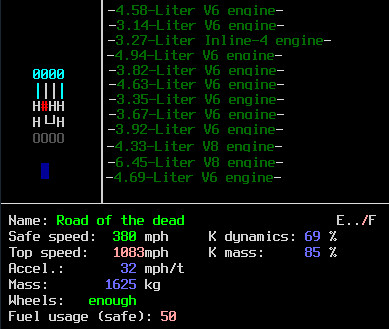
Replacing some engines with larger displacement ones.
I’ve got some ideas for a picture but you’ll need to take it for a ride or two first. Only dead legends get engravings.
Er, I mean, I’m not hoping that this thing flings your bloody corpse across the entire world or anything, buuuut… you knooow…
lil update some slightly larger engines, actually found a V8 6.54 liter but died carrying it back and had to reload from a earlier save, and it was sadly not there upon reloading.
theres just a seat with a steering wheel infront of it ontop of the 12 engines all linked together i’d guess, with real big tires and only a basic frame
To better understand this, imagine 2 rockets, they go at the same speed. If you turn them on and put them side to side, they will go at equal pace. Some people might think that double the thrust = double the speed. This is only partially right. You need to take into account the mass involved as well. In effect, what linking these two rockets together with massless tethers would make them go as fast as a single rocket. The ratio of mass and thrust hasn’t changed.
What you must do is to increase thrust without increasing mass. A more efficient engine is the way to go.
If I put an engine that weights 100 and gives 200 thrust, and then I strap that to an engine that weighs 20, but gives 15 thrust, this would not help at all.
No matter how many 20:15 engines you strap together, it will not go any faster than 15 thrust. In short, strapping an engine that can’t haul its own weight very well to a rocket that can haul its weight extremely efficiently is like putting dead weight onto the efficient rocket. Not only does the 100:200 rocket needs to haul its own mass, it must make up for the 20:15 rocket’s inefficient thrust now, and unlike before where they are not strapped together, the 100:200 rocket can no longer simply leave the 20:15 rocket in the dust and not worry about the weight.
[hr]
So how can you make a very fast vehicle? By adjusting the ratio of non-reactive mass, to reactive, or mass that will provide thrust.
A vehicle that weighs 100 and has engine power of 200, will move much faster than a vehicle that weighs 150 with the same engine power of 200. It’s like a square root function.The more engines you add, the less effective it will become compared to the previous ones you’ve added.[/quote]
I was trying to be funny, welp I guess I failed on that part but thanks for the lesson nonetheless
had to wake up early as hell because of work, played for a few minutes and found the motherload of engines in a garage atleast 6 V8’s. replaced all the engines with small displacements and here we have this.
still needs more power. BUT i plan on testing it either later tonight or maybe tommorow, im off for a longass drive
[size=8pt]gettin paid![/size]
23 mechanical skill is required for this many engines.
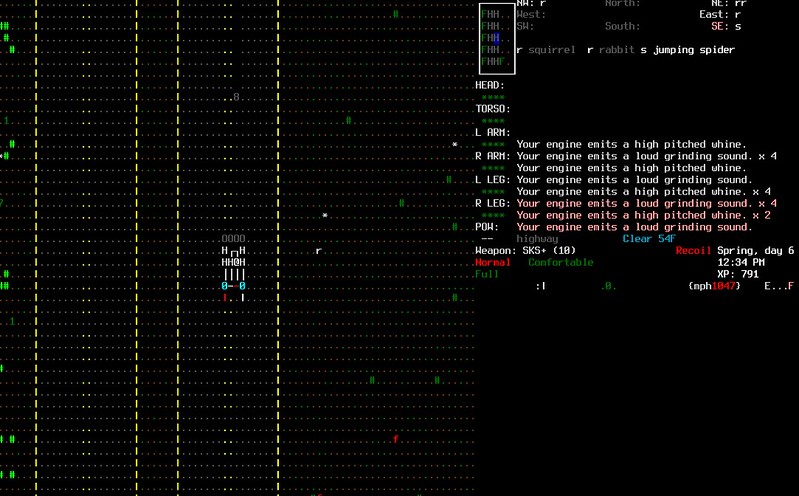
Edit: forgot to mention i actually did hit a higher speed than that after clearing the road, hit 1150 something but on the very next turn all the engines died. all 12. i pushed it to the limit.